
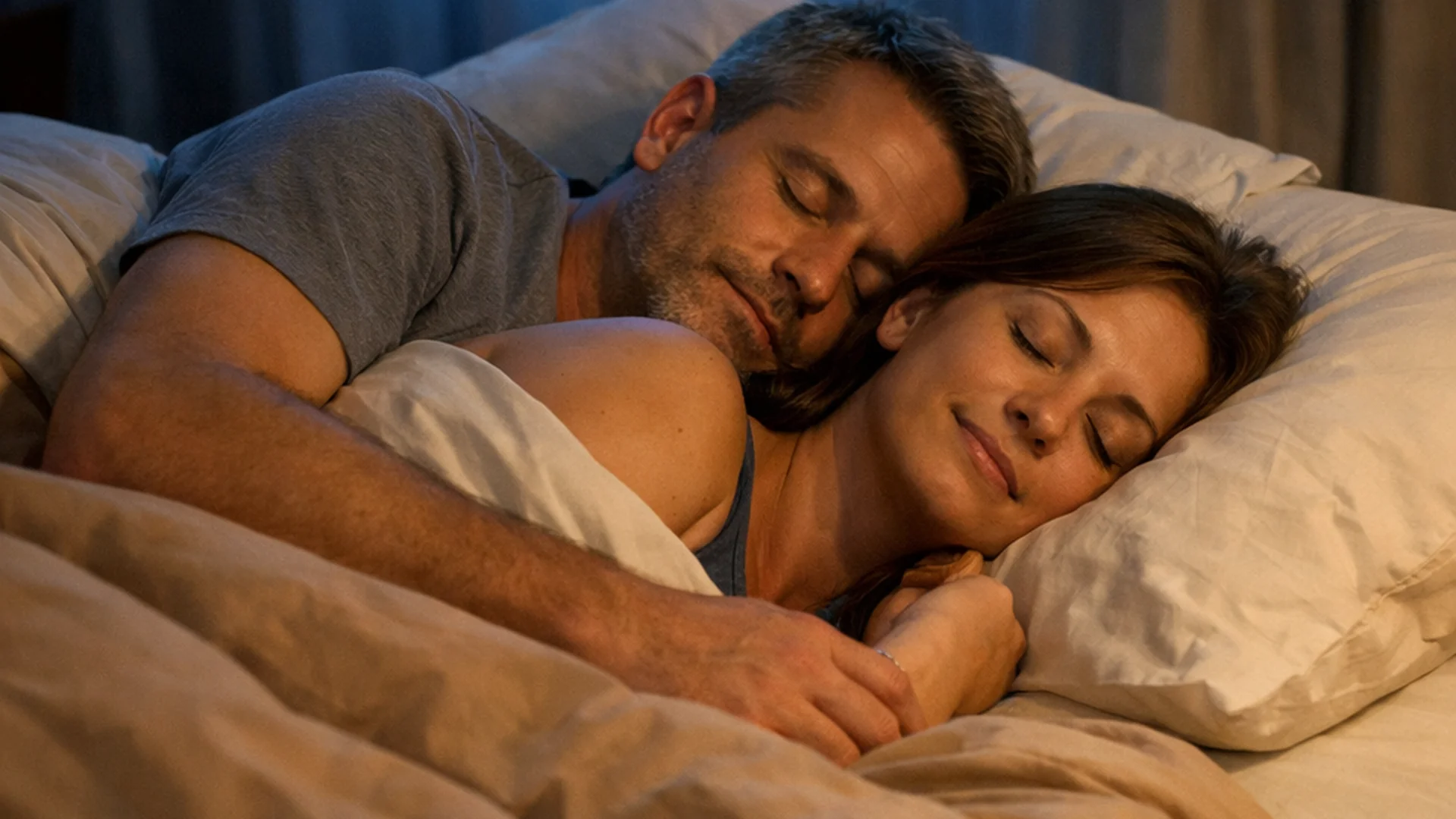
The short answer: sleeping as a couple is not just a habit — it is a coupled biological system, and it is one of the areas where relationship science has progressed most over the past twenty years. In 2007, the review by Troxel and colleagues (Sleep Medicine Reviews) established the founding framework: relationship quality influences sleep, and sleep influences relationship quality, in a loop. Since then, actigraphs and polysomnographs have shown that partners’ cycles synchronise, that the depth of the bond is readable in the architecture of the night, and that tomorrow’s argument is often written the night before.
Yet for decades, sleep science studied the isolated individual: one sleeper, one brain, one pillow. Most adults, however, share their bed — and that shared bed is a place of silent mutual regulation. This article brings together what the data actually establish about couples’ sleep: its synchronisations, its male-female asymmetries, its downsides, and the few practical principles that follow.
Sleep is a dyadic affair
The starting point is a simple observation: in a significant proportion of couples, sleep problems and relationship problems co-occur — and treating them separately means treating half the system. Troxel, Robles, Hall and Buysse (2007) proposed a biopsychosocial model with three pathways: sharing a bed can objectively disturb the partner’s sleep (movements, noise, temperature); sleep disorders (insomnia, apnoeas, periodic limb movements) erode mood, patience and intimacy; and relationship quality — security, perceived support, conflict — directly shapes the ability to fall asleep and to sleep deeply.
This framework makes sleep a full-fledged process of emotional co-regulation: the partner’s state is part of the night’s equipment, exactly as it is part of the day’s. The proof is that dyadic studies often open with this very sentence: coregulation of biological systems is a defining feature of normative adult attachment. The bed is where that co-regulation becomes physical, measurable, hour by hour.
What sensors and electrodes show: the bed synchronises
The first landmark study is Gunn, Buysse, Hasler, Begley and Troxel (2015, Sleep). Couples wore actigraphs for ten nights, and the researchers computed minute-by-minute sleep-wake concordance — the share of time both partners are in the same state. The result: concordance ranged from 53 to 88% across couples. It was unrelated to individual sleep quality or chronotype preference: it belongs to the couple, not to each sleeper.
The next step is striking. Drews and colleagues (2020, Frontiers in Psychiatry) ran twelve young couples through dual polysomnography — two wired brains during the same night, in the lab, twice together and twice apart. Verdict: sleeping as a couple came with roughly 10% more REM sleep, less fragmented REM (p = 0.008), longer uninterrupted episodes (p = 0.0006) — and, in honest counterpoint, more limb movements. Above all, the partners’ sleep architectures were significantly more synchronised when sharing a bed (p = 0.005), with detectable coupling within ± 5 minutes of lag. And synchronisation rose with the depth of the relationship as partners reported it: the more the bond matters, the more the brains dance together.
A two-way link: the night shapes the day, the day shapes the night
The direction of effects matters as much as their existence, and this is where Hasler and Troxel’s study (2010, Psychosomatic Medicine) is precious. Twenty-nine heterosexual couples completed seven days of actigraphy, sleep diaries and ecological assessment of their relational life, day after day. The results sketch an elegant asymmetry:
- For men, better sleep efficiency (diary) predicted less negative partner interaction the following day: the night precedes the day's tone.
- For women, the opposite dominated: less negative daytime interaction predicted better actigraphy-measured sleep efficiency the following night — the day precedes the night.
- Crossover effect: when women reported more positive and less negative interactions during the day, their male partners slept better that night. One person's relational mood is readable in the other's sleep.
- Concordance: among women only, greater divergence in sleep onset between partners predicted less positive and more negative interactions the next day.
The most striking evidence on direction comes from a therapy trial. Troxel, Braithwaite, Sandberg and Holt-Lunstad (2017, Behavioral Sleep Medicine) followed couples in marital therapy: among husbands, improvement in marital satisfaction over the course of therapy was associated with a 36% decreased risk of insomnia at follow-up. Improving the couple, at least for the men in this sample, also improved sleep.
Why does direction matter so much? Because the two halves of the loop call for different levers. When the night is the cause — a newborn, shift work, untreated apnoeas — no communication workshop will fix the daytime fallout until sleep is protected. When the relationship is the cause — chronic criticism, unresolved conflicts, insecure attachment — no mattress or earplug will fix the night until the climate changes. Couples who understand which half of the loop they are in stop treating the wrong organ.
Sleep, the invisible arbiter of arguments
If the night shapes the day, its best-documented relational consequences concern conflict. Gordon and Chen (2014, Social Psychological and Personality Science) combined a two-week daily diary with laboratory conflict discussions. Verdict: nights that were shorter or more restless than usual were followed by more frequent conflict and poorer resolution; in the lab, sleep-deprived participants showed reduced empathic accuracy and more negative affect during the discussion. In other words: after a bad night, the brain reads the partner’s intentions less accurately — exactly when it should do the opposite.
This mechanism sheds light on Gottman’s work on everyday exchanges detailed in our article on Gottman’s ratio and bids for connection: the “bids” missed on the morning after a bad night do not necessarily signal deep disinterest — they may be the effect of a brain under-fuelled by REM sleep. The reading grid changes: before concluding that the bond is drifting, it is legitimate to look at the week’s sleep.
When the shared bed becomes the problem
The downside is real. Sharing a bed exposes each person to the other’s snoring, apnoeas, periodic limb movements, schedule mismatches and body heat — and Drews’ study (2020) honestly confirms it: sleeping together also means more limb movements. The question is not “should we sleep together?” but “what does sharing cost and return, in our configuration?”
Two data points help arbitrate. First, concordance has health meaning: in 46 couples with no known sleep disorder, higher sleep-wake concordance was associated with lower nocturnal blood pressure and lower C-reactive protein (an inflammation marker) (Gunn et al., 2017, Sleep) — an association more marked among women for blood pressure. Second, the chronicle of separate beds: when one partner’s sleep is durably destroyed — untreated apnoeas, chronic insomnia, incompatible schedules — separate nights can protect both partners’ health without threatening the bond, provided it is negotiated and compensated with contact while awake. What damages a couple is not the guest room: it is the silent accumulation of fatigue, resentment and unspoken rejection.

Attachment keeps watch in the night
A final layer of reading: sleep carries the signature of attachment style. Troxel, Cyranowski, Hall, Frank and Buysse (2007, Psychosomatic Medicine) polysomnographically assessed 107 women with recurrent major depression. Women sharing their bed with a partner showed better sleep efficiency (p < 0.005), and married women fell asleep faster than never-married women. But women with anxious attachment showed a reduced percentage of stage 3-4 sleep — deep restorative sleep. The night, too, has attachment styles.
Gunn’s study (2015) details the couple dynamic: concordance was higher when wives reported strong marital satisfaction, regardless of husbands’ styles; in couples where wives were dissatisfied, concordance rose when husbands had an anxious attachment. Reading these data through attachment theory and our article on the anxious attachment style yields a coherent picture: for anxious attachments, sleeping in step can be a way of checking, all night long, that the bond holds.
The evidence at a glance
| Study | Method | Key finding |
|---|---|---|
| Troxel et al. (2007), Sleep Medicine Reviews | Literature review | Bidirectional sleep-relationship link; three-pathway biopsychosocial model |
| Troxel et al. (2007), Psychosomatic Medicine | Polysomnography, 107 depressed women | Bed partner → better sleep efficiency; anxious attachment → less stage 3-4 sleep |
| Hasler & Troxel (2010), Psychosomatic Medicine | Actigraphy + diaries, 29 couples, 7 days | Night prepares men’s day; women’s day prepares their night; crossover effects |
| Gunn et al. (2015), Sleep | Actigraphy, 10 nights | Concordance 53-88%; linked to wives’ satisfaction and husbands’ attachment |
| Drews et al. (2020), Frontiers in Psychiatry | Dual polysomnography, 12 couples | ~10% more REM, less fragmented; sleep-stage synchronisation within ± 5 min |
| Gordon & Chen (2014), SPPS | 2-week diary + lab | Poor night → more conflict, less empathic accuracy next day |
| Troxel et al. (2017), Behavioral Sleep Medicine | Marital therapy trial follow-up | Improved husbands’ satisfaction → 36% lower insomnia risk |
| Gunn et al. (2017), Sleep | Actigraphy + ambulatory BP, 46 couples | Higher concordance → lower blood pressure and inflammation (CRP) |
Five levers for better sleep as a couple
Research offers no universal manual, but it draws solid principles:
- Treat sleep as a couple topic, not two individual ones. One partner's night efficiency depends on the other's daytime climate: the question «how did you sleep? » deserves as much attention as «how was your day? ».
- Address objective disorders first. Snoring, suspected apnoeas, periodic limb movements: medical advice (sometimes a simple sleep-apnoea screening prescription) can make the shared bed peaceful again within weeks.
- Negotiate the bedtime. Among women, divergence in partners' sleep onset predicted more negative next days (Hasler & Troxel, 2010). Going to bed at the same hour is not a romantic detail: it is preventive maintenance.
- Protect the day after bad nights. After a short night, postpone the big discussions (moving, budget, sensitive topics) by a day or two, and explicitly grant each other a second reading of the other's intentions — empathic accuracy returns with sleep.
- Accept adjustment without dramatising. Occasional or durable separate nights, negotiated and compensated with wakeful contact, protect both partners' sleep — and thereby the bond. The bed is not the marriage.
Going further
Sleeping as a couple brings together two literatures — the couple’s and the night’s — and it is rare to see them read together. To go deeper on the sleep side, with concrete synchronisation measures and ideas for arranging the shared bed, ton-sommeil.fr publishes a piece on what sleep measurements reveal about couples who share a bed. And if bad nights settle into a climate of lasting conflict, the bond is what needs care first: a couples therapist works precisely on the day-night loop described here.