

Roughly one in five adults carries through their romantic life a persistent, low-grade alarm — a background hum of worry that the person they love might leave, that they are not quite enough, that any silence or delay carries a message of withdrawal. This is not a character flaw or a personality defect. It is what attachment researchers call the anxious attachment style, first documented in adult relationships by Cindy Hazan and Phillip Shaver in their landmark 1987 study — whose foundational work is fully detailed in our guide to attachment theory. All resources on this theme are gathered in our thematic section Attachment. The research has since been replicated across dozens of cultures and contexts.
Understanding anxious attachment does not mean accepting it as a permanent feature of who you are. It means identifying the logic of a system that made sense at a specific moment in your development — and recognizing that the same system, deployed in adult relationships, often creates exactly the outcomes it was designed to prevent.
8 Signs You Have an Anxious Attachment Style
These signs are not a checklist for self-diagnosis but patterns to observe in your own relational behavior — ideally with curiosity rather than judgment.
1. You monitor your partner’s signals constantly. You read their messages for shifts in tone, notice when they seem quieter than usual, and draw inferences from delays in response that others would not register. This is not paranoia — it is a finely tuned attentional system that has been calibrated to detect relational threat. The problem is that it generates false alarms constantly.
2. You need reassurance that the relationship is solid, frequently. “Are we okay?” asked once after a conflict is normal. Asked three times a week during a calm period is reassurance-seeking as anxiety management. The relief produced is real but short-lived, which means the cycle repeats. Mario Mikulincer and Phillip Shaver (2003) call this “hyperactivating strategies” — amplifying attachment distress to draw the caregiver closer, a pattern learned in infancy and not yet updated.
3. Separations cause disproportionate distress. A weekend apart, a partner absorbed in a work deadline, a friend trip that pulls them away — these situations generate anxiety that feels bigger than the situation warrants. The distress is not about distrust of the specific partner; it is a nervous system that reads distance as early-warning abandonment.
4. You interpret neutral behavior as withdrawal. A shorter-than-usual text message. A partner who needs a night alone. A forgotten plan. For the anxiously attached, these events are not neutral — they are data points to be assessed for what they might mean about the relationship’s safety. This interpretation bias is one of the most robustly documented features of the anxious attachment style.
5. You find yourself caught in a self-fulfilling loop. The behaviors generated by anxiety — checking in too frequently, seeking reassurance in ways the partner experiences as pressuring, interpreting innocent actions negatively and reacting to those interpretations — can produce the distance and disengagement that the anxious person feared. The partner feels overwhelmed; they pull back; the withdrawal confirms the original fear. This cycle is not evidence of a bad relationship. It is evidence of an anxious attachment system working exactly as designed.
6. You struggle to self-regulate during relational uncertainty. When conflict arises or ambiguity enters the relationship, the pull toward immediate resolution is intense — even if the timing is poor, even if both partners need space. The capacity to sit with unresolved relational questions, to tolerate not knowing for a few hours or a day, is genuinely underdeveloped in anxious attachment. This is not weakness; it is an underpracticed skill.
7. Your self-worth is closely tied to how your partner sees you. Attachment theorists speak of “internal working models” — mental representations of the self and others in relationship. In anxious attachment, the working model of the self tends to be negative (“I am not enough, not lovable, too much”) while the model of others is positive (“others are capable of love and worthy of it”). This asymmetry means your partner’s mood, attention level, and expressions of affection become not just pleasant or unpleasant — they become measures of your worth.
8. You are attracted to partners who feel just out of reach. Levy and Davis’s 1988 research documented what clinicians see repeatedly: anxiously attached people disproportionately enter relationships with avoidantly attached partners. The avoidant partner’s emotional distance, self-sufficiency, and need for space triggers the anxious person’s alarm system — making the relationship feel urgent, intense, and preoccupying. What reads as chemistry is often the anxious attachment system activating in response to a familiar threat. For readers looking to understand how attachment patterns affect attraction and early relationship dynamics, Charisme Séduction offers complementary perspectives on this early stage.
The Developmental Origins: How This System Got Built
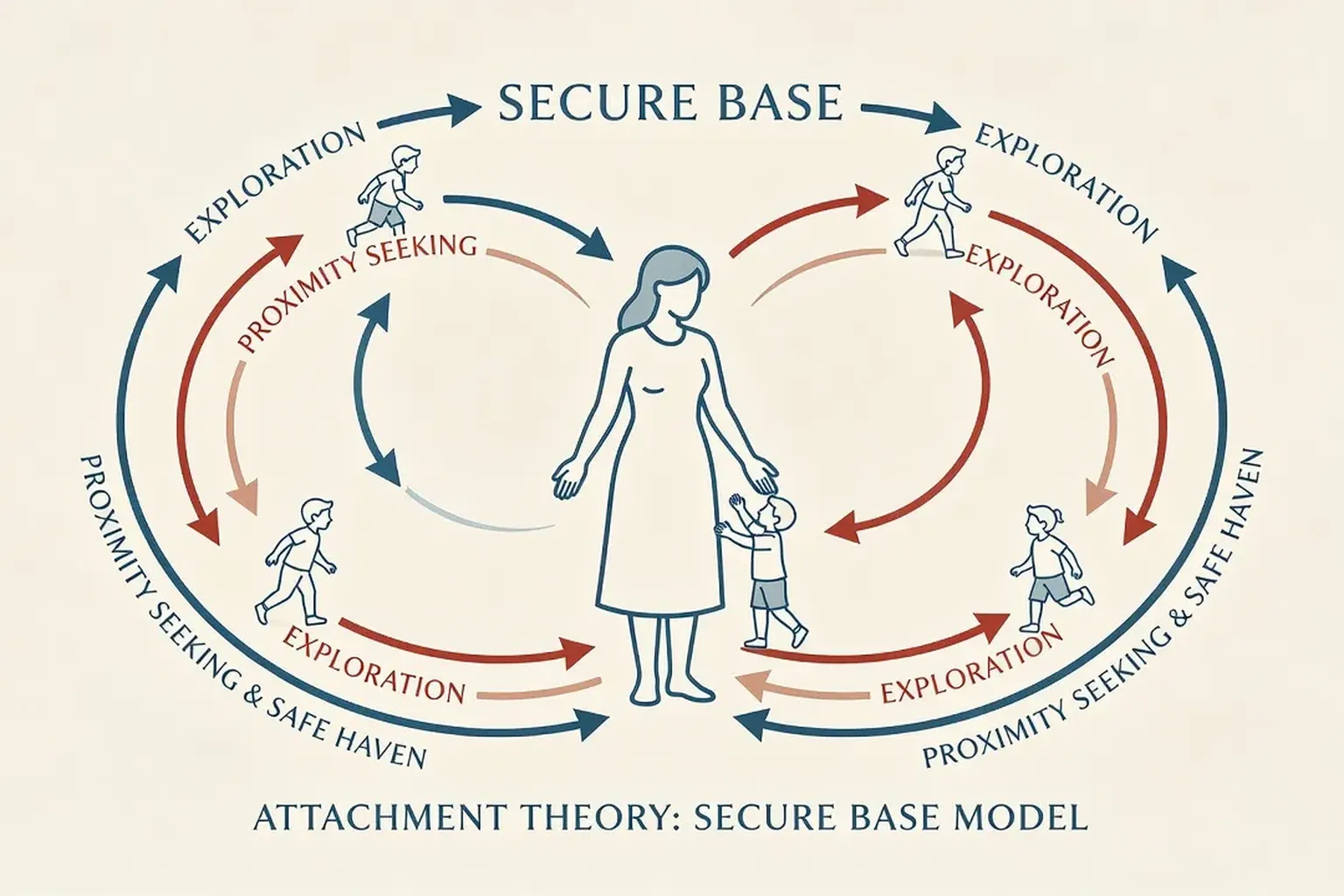
John Bowlby’s attachment theory begins from a simple evolutionary observation: human infants are completely dependent on their caregivers for survival. The attachment behavioral system — crying, reaching, clinging — evolved to ensure that infants maintain proximity to protection. From this system, a secondary question emerges: what strategy does the infant develop when the caregiver’s responses are unpredictable?
Mary Ainsworth’s Strange Situation experiments in the 1970s identified what she called “anxious-ambivalent” attachment in infants whose caregivers were inconsistently responsive — warm and attentive sometimes, emotionally unavailable or misattuned at others. These infants learned that amplifying their distress signals increased the probability of a response. They clung harder, cried louder, protested more dramatically. The strategy worked — intermittently.
Anxious attachment strategies are not signs of weakness — they are signs of intelligence. They represent the infant's best solution to an unpredictable environment. The tragedy is that they continue running in contexts where they are no longer needed.
— Phillip Shaver & Mario Mikulincer, Attachment in Adulthood, 2007The developmental precursors associated with anxious attachment in adults include: caregivers who were emotionally inconsistent — responsive and loving sometimes, withdrawn or preoccupied at others; early separation experiences that were not adequately prepared or explained; family environments where emotional expression was simultaneously encouraged and punished depending on the caregiver’s state; and contexts of chronic parental stress in which the caregiver’s own emotional dysregulation made them unavailable.
Crucially, these origins do not constitute determinism. The Minnesota Study of Risk and Adaptation, which followed over 700 families from birth to adulthood, found that attachment patterns could shift significantly across development in response to changing relational environments.
How Anxious Attachment Plays Out in Romantic Relationships
Hazan and Shaver’s 1987 study was the first to demonstrate that the three attachment patterns Ainsworth had identified in infants — secure, anxious-ambivalent, and avoidant — showed up in adult romantic relationships with remarkably similar proportions and behavioral signatures. Their newspaper survey asked thousands of adults about their relationship histories and styles. Roughly 20% described patterns consistent with anxious attachment.
In adult romantic relationships, the anxious attachment style tends to produce a recognizable arc. Early in relationships, the anxious person often experiences intense, immediate connection — what they may describe as “finally feeling seen.” Investment comes quickly and deeply. The relationship becomes central to emotional life in ways that can feel overwhelming to a partner still in an earlier stage of connection.
As the relationship stabilizes, the anxiety does not settle — it finds new objects. Every fluctuation in the partner’s mood becomes potentially significant. The pursuit of reassurance, initially received with warmth, begins to feel like a demand. The partner — particularly if avoidantly attached — starts needing more space. This need for space activates the anxious person’s alarm system, producing more pursuit, which generates more withdrawal, completing the pursuer-distancer cycle first described by Thomas Fogarty and later elaborated by Sue Johnson. Understanding these dynamics is central to developing effective couple communication. For a French-language perspective on the same patterns, see our article Style d’attachement anxieux.
Bowlby described “protest behaviors” — the anxious infant’s escalating attempts to restore proximity to a retreating caregiver — as a normal feature of the attachment system. In adults, protest behaviors include: repeated calls or messages when the partner is not responding, insistence on having difficult conversations immediately, emotional escalation during conflict, and sometimes threats of ending the relationship as a way of forcing engagement. These behaviors are not strategic manipulation. They are the attachment system firing at high intensity.

Can Anxious Attachment Change? What the Research Says
The short answer is yes, and the evidence for this is substantial. Attachment style is not a permanent trait etched in neurology. It is a learned relational strategy that can be updated — and research identifies several mechanisms through which this happens.
Corrective relational experiences. A secure romantic partner — someone who is consistently available, emotionally responsive, and non-punishing of vulnerability — can gradually update the internal working models that underpin anxious attachment. This process, described by Ruvolo, Fabin, and Ruvolo (1999), takes time. Internal working models are not cognitive beliefs that can be swapped out intellectually; they are deeper representations built from repeated experience. A secure partner provides the repeated experiences that allow those representations to be revised.
Longitudinal studies. The Minnesota Longitudinal Study and research by Waters, Merrick, Treboux, Crowell, and Albersheim (2000) found significant rates of attachment style change across development — particularly in response to major life events like significant relationships, therapy, or trauma processing. Approximately 25% of participants shifted attachment classifications over a four-year period.
Emotionally Focused Therapy (EFT). Sue Johnson’s approach, developed across four decades of clinical research, is the most extensively validated couple therapy currently available. EFT conceptualizes couple conflicts as “attachment panic calls” — attempts, often maladroit, to get unmet attachment needs acknowledged. The therapy creates conditions for partners to express those underlying needs directly, and for the other partner to respond with genuine empathy. Johnson’s outcome studies show 70-73% of couples moving out of clinical distress after EFT, with gains maintained at two-year follow-up (Johnson et al., 1999) — a question that whether and how these patterns change is more genuinely debated than popular accounts suggest, as our editorial interview on earned secure attachment examines honestly.
Individual therapy. Mentalization-Based Treatment (MBT), developed by Peter Fonagy and colleagues, specifically targets the capacity to reflect on one’s own and others’ mental states — a capacity that is often underdeveloped in anxious attachment. By improving mentalization, MBT reduces the intensity of automatic threat responses in relational situations.
6 Evidence-Based Strategies to Build More Secure Attachment
These strategies will not eliminate anxiety overnight. They offer leverage points for incremental change — which is how attachment patterns actually shift.
1. Name the feeling before you act on it. Before sending the “checking in” message, before initiating a conversation that cannot wait, before interpreting a short text as evidence of withdrawal — pause and name the emotion driving the impulse. “I am feeling anxious because I haven’t heard from them since this morning” is more precise and more useful than “Something must be wrong.” This micro-pause between activation and response is the beginning of self-regulation.
2. Broaden your secure base. Anxiously attached people tend to concentrate their emotional investment in a single relationship, which mechanically raises the stakes and therefore the anxiety. Developing a diverse network of secure relationships — close friendships, reliable family connections, communities of practice or interest — distributes the need for security across multiple sources. This reduces the weight any single relationship must carry.
3. Work with your internal working models. Cognitive approaches to attachment therapy invite examination of the automatic beliefs that operate beneath anxious behavior: “I am too much,” “I will eventually be left,” “My needs are a burden.” These beliefs feel like observations about reality but are better understood as working hypotheses built from limited early data. Examining them against the actual evidence of your adult relationships — ideally with a therapist — can begin to revise them.
4. Practice tolerating uncertainty. The capacity to tolerate relational ambiguity — not knowing exactly where things stand, sitting with an unresolved conversation for a day, accepting that your partner needs time alone without treating it as a referendum on your relationship — is a skill that can be developed through progressive exposure. Start small: wait an additional thirty minutes before responding to an anxious impulse. Let a minor irritation pass without seeking immediate resolution. Each small tolerance builds the capacity for larger ones.
5. Develop individual self-regulation skills. The anxious attachment system is, at its core, a nervous system regulation problem — specifically, the difficulty of self-regulating without external support. Practices that strengthen individual emotional regulation — mindfulness meditation, regular exercise, diaphragmatic breathing, expressive writing — reduce the baseline activation level of the nervous system. When less activated at rest, the attachment alarm triggers with less intensity.
6. Consistency over time. One of the underappreciated aspects of attachment change is that it requires sustained new experience, not insight alone. Understanding why you are anxiously attached is useful but not sufficient. What changes the underlying representations is sustained relational experience that contradicts them — a partner who is genuinely available when you are vulnerable, repeated experiences of resolving conflict without catastrophe, accumulated evidence that your needs can be expressed without driving people away. Expanding your sources of genuine connection beyond the primary relationship — as Cacioppo’s research on the science of loneliness strongly recommends — also reduces the pressure on any single relationship to meet all security needs.
When to Seek Professional Help
Self-help strategies are valuable starting points, but professional support is indicated when:
- Relationship anxiety significantly interferes with daily functioning — concentration at work, sleep quality, social relationships
- The behaviors generated by anxiety create recurring conflict cycles that the couple cannot exit without third-party support
- Early experiences of neglect, abuse, or significant loss appear to be contributing to current anxiety
- Self-directed strategies have not produced observable change after several months of consistent effort
The most validated approaches for anxious attachment include Emotionally Focused Therapy (EFT) for couples, EMDR (Eye Movement Desensitization and Reprocessing) for underlying early trauma, and Mentalization-Based Treatment (MBT) for developing reflective functioning. For a practical guide to finding an attachment-informed therapist, see our article on choosing an attachment-based therapist for anxious attachment.
Anxious attachment is not a life sentence. It is an adaptation — a set of strategies that were reasonable responses to the relational environment of early life, carried forward into contexts where they no longer serve their original purpose. What does replicate consistently: change, when it happens, tends to be gradual and effortful, built through sustained secure experience, therapeutic work, and the accumulation of evidence that it is safe, this time, to let someone close, including a major study that complicates the simple “you can rewrite your attachment” narrative. When attachment injuries occur within committed relationships, our interview on rebuilding trust after betrayal explains how EFT addresses these ruptures at the deepest level.
The person you become through that process is not a different person than the one who learned to be anxious. It is the same person, living with less alarm.