

For forty years , John Gottman and his colleagues at the Gottman Institute have filmed thousands of couples arguing, having lunch, and resolving conflicts. From this meticulous observation emerged a list of behaviors that Gottman called “the Four Horsemen of the Apocalypse”—communication patterns that predict breakups with astonishing accuracy. All resources on this topic are brought together in our Communication section. Dr. Isabelle Morin, a clinical psychologist specializing in couples therapy, has used these tools for fifteen years with the couples she supports. She explains them to us with the precision of a practitioner and the depth of a researcher.
Dr. Morin, let’s start at the beginning. What is John Gottman’s Four Horsemen model, and where does it come from?
The model is the result of several decades of observational research—what Gottman himself calls the “Love Lab” at the University of Washington. Gottman and his colleagues followed couples for years, recording their interactions and measuring physiological variables: heart rate, electrodermal conductance, facial expressions coded frame by frame. What sets this work apart is its predictive nature. Gottman did not merely describe conflicts—he sought to identify what, within those conflicts, could predict whether a couple would stay together or separate.
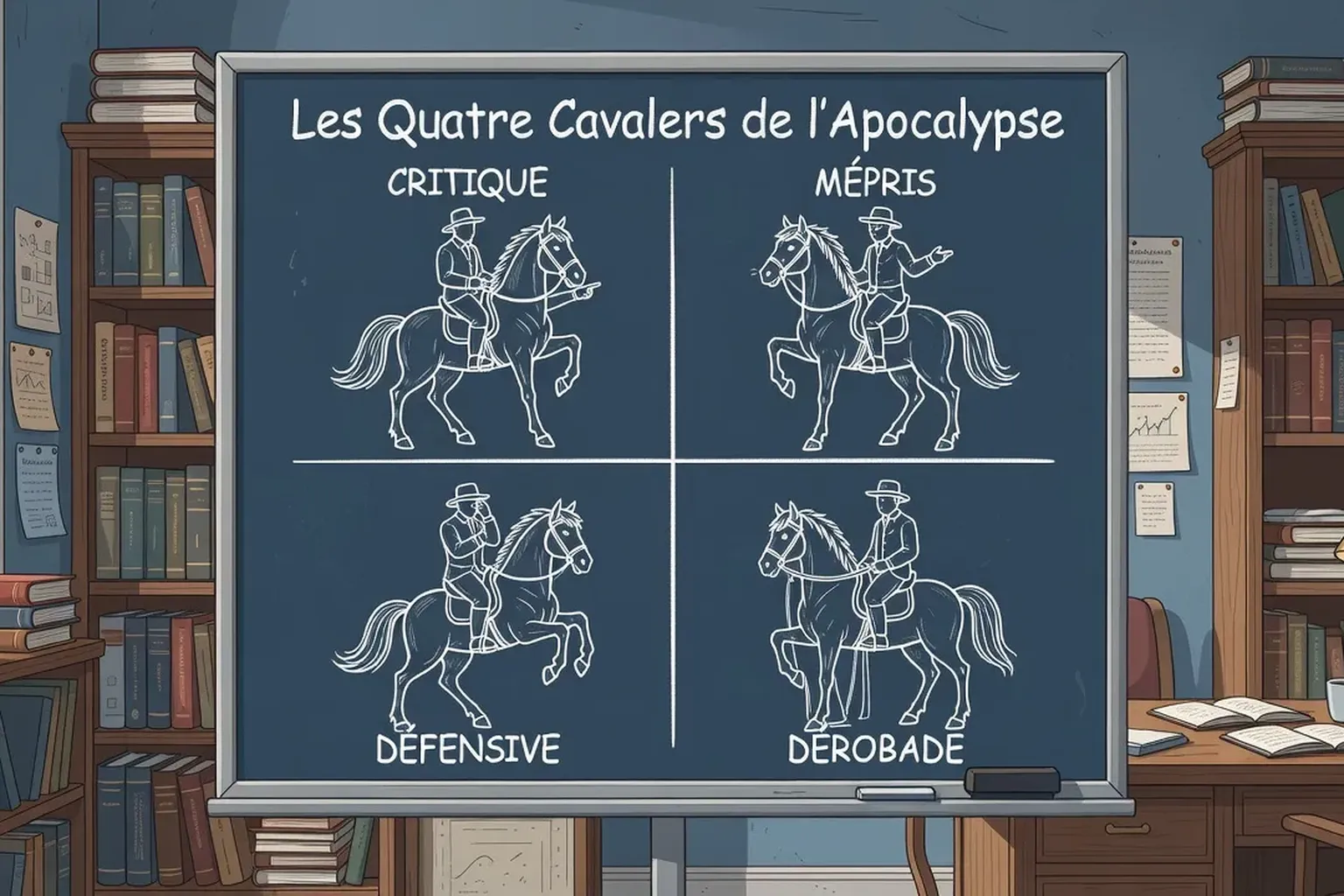
The Four Horsemen are the 4 behaviors for which this prediction is the most robust. They are criticism, contempt, defensiveness, and withdrawal—which English speakers call stonewalling. Their combined presence in a couple’s interactions enabled Gottman to predict divorce with 93% accuracy in some studies. That is a figure that always impresses my students.
What is important to understand is that these behaviors are not “character flaws.” They are learned communication strategies, often inherited from our family environment, which may have been functional at some point. The problem is that they become toxic in the context of an intimate relationship—and gradually erode marital satisfaction. In contrast to these Four Horsemen, our interview on repairing conflicts between couples explores the behaviors that predict a relationship’s resilience after an argument.
Tell us about the first horseman: criticism. How can it be distinguished from a legitimate complaint?
It is a fundamental distinction, and I return to it systematically with my patients because it changes everything about how conflicts are approached. Gottman is very precise on this point: a complaint focuses on a specific behavior. “You didn’t call your mother for her birthday like you said you would”—that is a complaint. There is an identifiable fact, an implicit request for change.
Criticism, on the other hand, attacks the person’s overall personality. “You’re selfish; you never think about others.” Do you see the difference? We move from a behavior to an identity label. And the problem with an identity label is that it leaves no way out. How can you change if what you are being told is that it is in your nature?
In my practice, I often hear patients say, “But I’m just telling them how I feel.” Yes—but form matters as much as substance. Phrases such as “You always…,” “You never…,” and “You’re the kind of person who…” are linguistic markers of criticism. The antidote proposed by Gottman is a complaint expressed in terms of a need: “When X happens, I feel Y, and I would need Z.” It is more laborious, but it remains focused on behavior rather than identity.
Contempt is described as the most destructive of the four. Why?
Gottman says that contempt is “the sulfuric acid of love,” and that phrase is not merely a metaphor. In the Love Lab studies, the presence of contempt in a couple’s interactions is the strongest predictor of separation—more so than the other three horsemen combined.

One finding always strikes me: Gottman and Levenson (1992) showed that couples in which contempt is frequent have weakened immune systems. Partners subjected to chronic contempt are sick more often. The body registers what the psyche endures.
The antidote to contempt is not the absence of contempt—it is the active cultivation of appreciation and respect. Gottman speaks of “love maps”—intimate knowledge of the other person’s inner world, their dreams, fears, and values. Couples who cultivate this knowledge have a reservoir of goodwill that withstands tension. Contempt thrives in couples where that reservoir has long been empty.
Contempt communicates disgust. It does not say, ‘You behaved badly,’ but ‘You are nothing to me.’ No relationship can survive that message for long.
— Dr. Isabelle MorinDefensiveness—it is a mechanism everyone uses. How do you know when you have crossed the line?
Defensiveness is particularly tricky because it presents itself as self-protection—and that is indeed what it is. When someone criticizes us, our natural reflex is to defend ourselves. The problem is that defensiveness completely blocks communication.
In practical terms, defensiveness manifests through several characteristic behaviors:
- Counterattacking—“You do the same thing!”
- Denying all responsibility—“It’s not my fault”
- Playing the martyr—“I do everything around here, and on top of that I get criticized”
- Resorting to “yes, but” statements that cancel out any concession
What makes defensiveness so treacherous is that the partner using it often feels they are the victim of an injustice. And sometimes, objectively, the criticism they received was poorly phrased or unfair. But defensiveness does not address that—it escalates the situation.
The antidote proposed by Gottman is partial responsibility. Not a complete mea culpa, but an attempt to find the truth in what the other person is saying, even when the criticism is clumsy. “I understand that you felt ignored when I was scrolling on my phone—you’re right that it’s a complaint I need to think about.” This is difficult to do in the heat of the moment. That is why many couples need a therapeutic setting in which to learn—and why communication between couples is an acquired skill, not an innate talent.
Withdrawal, or stonewalling, is often perceived as a manipulation strategy. Is that fair?
It is a very widespread misunderstanding, and it creates a great deal of additional suffering. The person on the receiving end of stonewalling—the silence, the refusal to respond, leaving the room—often experiences it as rejection or punishment. And they become angry and escalate, which makes everything worse.
But in Gottman’s research, stonewalling is almost always a response to physiological overwhelm—what he calls “flooding.” When the heart rate exceeds 100 beats per minute, the prefrontal cortex—the seat of rational thought and empathy—is literally offline. The person can no longer listen or respond constructively. At that point, withdrawing is the only option their nervous system offers them.
The problem is that the partner sees only the withdrawal, not the physiological state producing it. Gottman’s antidote is elegant: a physiological break of at least 20 minutes. Twenty minutes because that is how long the autonomic nervous system needs to return to a level of activation compatible with rational communication. During this break, each partner must do something non-ruminative—read, walk, make music. Dwelling on grievances sustains the flooding. And then, come back.
In your practice, how do couples use these tools in practical terms on a daily basis?
The transformation of initial passion into lasting love—which we analyze in our article on companionate love and passionate love—makes this work all the more necessary as the years go by. What I observe is that simply identifying the horsemen already has an effect. When a couple can name what is happening—“right now, you’re criticizing me” or “I feel myself starting to stonewall”—it creates a metacognitive distance from the dynamic. We do not stop it immediately, but we begin to see it.
Then there is what I call “ritual pause work.” I encourage couples to agree, outside of conflicts, on a signal—a word, a gesture—that means: “I’m reaching my limit; I need a 20-minute break.” This signal, established when both partners are calm, is much easier to access than asking for a break in the middle of an argument.
What often surprises couples is discovering that the horseman they identify in the other person is one they also use themselves—just in other situations or in other forms. This reframing—“we all do these things; the question is how often and how intensely”—reduces guilt and opens up a space for working together.
Are there cultural differences in how these behaviors are expressed?
It is a question I find fascinating and underdocumented. Gottman’s research was conducted primarily in the United States, on predominantly white, middle-class populations. His findings have been replicated in other cultures, but the forms of expression of the horsemen vary.
In some cultures where direct emotional expression is less valued, contempt may take more coded forms—a particular silence, a way of talking about the other person in their absence, micro-behaviors that only the partner understands. Stonewalling may be normalized in cultures where “not making waves” is valued.
What I observe in France is that intellectualized criticism—wrapped in sophisticated rhetoric—can be more difficult to identify as such. “I’m not criticizing you; I’m objectively explaining why you’re wrong” is criticism dressed up as rationality. The form changes; the process is the same.
Summary
| Horseman | Description | Antidote (Gottman) |
|---|---|---|
| Criticism | Attacks the partner’s overall personality (“You’re selfish”) rather than a specific behavior | Complaint expressed in terms of a need: “When X happens, I feel Y, and I would need Z” |
| Contempt | Communicates moral superiority—sarcasm, eye-rolling, ridicule. The most destructive of the four | Active cultivation of appreciation and respect; maintaining “love maps” |
| Defensiveness | Counterattacking, denying all responsibility, playing the martyr, using “yes, but” statements | Partial responsibility: looking for the truth in the criticism received, even if it is clumsily expressed |
| Stonewalling | Completely shutting down communication, often in response to physiological overwhelm (“flooding”) | Physiological break of at least 20 minutes, with a non-ruminative activity |
Finally, if someone recognizes themselves in these patterns, where should they begin?
With observation, without judgment.
If you are looking to understand the dynamics of seduction and communication in your relationships, the Conseil Séduction website offers complementary approaches focused on relationship behaviors.
Keep a journal for a week: which conversations with my partner went well? Which went badly? What was said in each case? This dispassionate observation often makes it possible to identify one’s dominant horseman—the one used most often.
Then I recommend reading Gottman directly—“The Seven Principles for Making Marriage Work” is accessible and well documented. And if observation reveals longstanding, persistent patterns accompanied by significant distress, I recommend consulting a couples therapist. Not necessarily during a crisis—preventive therapy, like preventive medicine, is often far more effective.
The Four Horsemen are not a sentence. Almost all of us use them, to varying degrees. The difference between couples who last and those who separate does not lie in the absence of conflict—it lies in how they move through it. This is something we also analyze in our article on anxious attachment style, which describes how insecurity amplifies these patterns. Find all our articles in the blog listing.
Dr. Isabelle Morin’s remarks are based on the work of John Gottman et al. (The Seven Principles for Making Marriage Work, 1999; Why Marriages Succeed or Fail, 1994). Interview conducted by the ISSPR.org editorial team.