

Research on relationship satisfaction has produced one finding that consistently surprises people: the factors that predict whether a couple stays happy over the long term have very little to do with compatibility in the conventional sense — shared interests, similar backgrounds, or even values alignment — and almost everything to do with how partners interact in ordinary daily moments.
John Gottman’s longitudinal research, conducted over four decades at the University of Washington and the Gottman Institute, identified patterns in couple behavior that predict relationship outcomes with extraordinary accuracy — patterns detailed in our scientific guide to relationship satisfaction. Robert Sternberg’s triangular model of love explains what components sustain relationships through time. Arthur Aron’s self-expansion theory shows why novelty and challenge matter for lasting desire. Shelly Gable’s research on capitalization reveals that how partners respond to good news may matter as much as how they support each other through difficulties.
What follows is not relationship advice in the motivational sense. These are specific, research-grounded behaviors — the things that, according to the evidence, actually make a measurable difference to long-term relationship satisfaction.
| # | Strategy | Key researcher |
|---|---|---|
| 1 | Practice the 5:1 positive-to-negative ratio | John Gottman |
| 2 | Create shared meaning and rituals | John Gottman |
| 3 | Turn toward your partner’s bids for connection | John Gottman |
| 4 | Practice active constructive responding | Shelly Gable |
| 5 | Maintain physical affection independent of sex | Anik Debrot |
| 6 | Pursue novelty together | Arthur Aron |
| 7 | Repair after conflict | John Gottman |
| 8 | Maintain your individual identity | Arthur Aron |
| 9 | Express gratitude specifically and regularly | Amie Gordon |
| 10 | Discuss future goals together | Robert Sternberg |
| 11 | Practice emotional bids awareness | John Gottman |
| 12 | Learn your partner’s love language — with nuance | Gary Chapman / Goff et al. |
| 13 | Manage your own stress first | Stress spillover research |
| 14 | Seek relationship education proactively | Gottman / Sue Johnson |
| 15 | Build a supportive social network around the couple | John Cacioppo |
1. Practice the 5:1 Positive-to-Negative Ratio
Gottman’s research established what he called the “magic ratio”: for every negative interaction in a relationship, couples who maintain long-term satisfaction have approximately five positive interactions. Negative interactions — criticism, dismissiveness, irritation — carry more emotional weight than positive ones, so they must be counterbalanced by a significant surplus of connection, humor, affection, and appreciation. This does not mean avoiding all conflict. It means ensuring that the overall emotional climate of the relationship is consistently more positive than negative. Couples who fall below a 5:1 ratio in their daily interactions show measurably higher divorce rates within years.
2. Create Shared Meaning and Rituals
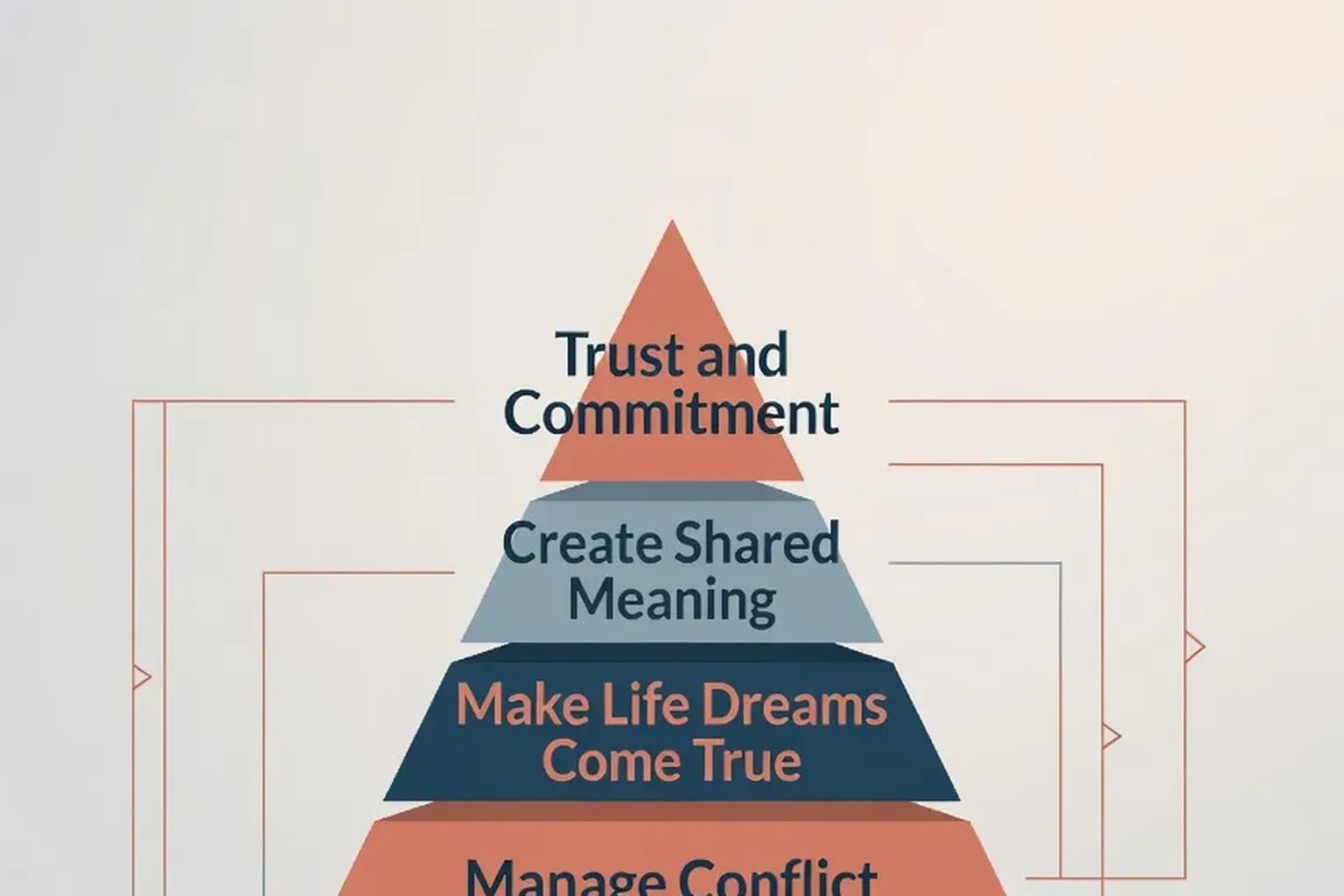
Gottman’s “Sound Relationship House” model places shared meaning at the top — the roof that protects everything else. Couples who build a shared culture — rituals around meals, transitions, celebrations, or simply how they greet each other at the end of the day — have a structural resource that withstands individual conflict and stress. These rituals do not need to be elaborate. The question “How was your day?” asked genuinely and followed by actual listening is a ritual. What matters is that they are consistent, mutual, and felt as meaningful by both partners. Couples who lack shared meaning often report a creeping sense of parallel lives even when outward conflict is low.
3. Turn Toward Your Partner’s Bids for Connection
This is arguably the finding with the most practical leverage in all of Gottman’s research. “Bids for connection” are the small, often indirect attempts one partner makes to engage the other — a comment about something outside the window, a funny observation about a TV show, a sigh. The partner can respond by turning toward (acknowledging, engaging), turning away (ignoring), or turning against (dismissing or criticizing). Couples who turned toward each other in these micro-moments 86% of the time in Gottman’s lab observations stayed married in follow-up studies. Those who turned toward only 33% of the time divorced at very high rates within six years. The bid-and-response cycle is the heartbeat of relational life.
4. Practice Active Constructive Responding
Shelly Gable, a psychologist at UC Santa Barbara, found that how partners respond to each other’s good news is at least as important for relationship quality as how they respond to bad news. She identified four response styles: active constructive (enthusiastic, curious engagement), passive constructive (quiet acknowledgment), active destructive (finding the negative angle), and passive destructive (ignoring or redirecting). Only active constructive responding — “Tell me more, how did that happen?” — is associated with higher relationship satisfaction, deeper intimacy, and greater relationship longevity. Celebrating together, it turns out, builds bond in ways that are distinct from supporting through hardship. Both matter.
5. Maintain Physical Affection Independent of Sex
Research by Anik Debrot and colleagues at the University of Lausanne (2013) found that non-sexual physical affection — hugging, hand-holding, a touch on the shoulder, sitting close — independently predicts relationship satisfaction and individual wellbeing, even after controlling for sexual satisfaction. The mechanism appears to involve the oxytocin system: casual, affectionate touch activates the same bonding circuitry as more intimate contact, but at a lower intensity that can be sustained throughout daily life. Couples who maintain physical warmth as a daily habit — not reserved only for sexual or emotionally significant moments — report higher baseline satisfaction.
6. Pursue Novelty Together
Arthur Aron’s self-expansion theory predicts that relationship satisfaction declines when the couple stops offering each other new experiences, perspectives, or capacities. The early stage of love is neurobiologically marked by rapid self-expansion — everything about the other person is new, stimulating, and growth-producing. Aron’s intervention research shows that couples who regularly pursue novel, stimulating activities together reactivate the dopamine circuits associated with early love. The activity does not need to be romantic — it needs to be genuinely new and challenging for both. A cooking class, a hiking route neither has tried, learning a language together. The shared challenge is what matters, not the romantic packaging.
7. Repair After Conflict
Gottman found that the presence of conflict is not a reliable predictor of relationship dissatisfaction — its absence can even be a warning sign, suggesting avoidance rather than health. What predicts dissatisfaction is the failure to repair after conflict: the inability to de-escalate, acknowledge the other’s perspective, and return to connection. “Repair attempts” — any verbal or nonverbal gesture that attempts to reduce tension during or after a fight — predict relationship success more strongly than the intensity of the conflict itself. For a deeper dive into these communication patterns, see our guide on couple communication. Gottman identified four specific behaviors — criticism, contempt, defensiveness, and stonewalling — that systematically block repair; our interview on the Four Horsemen of the Apocalypse explores each one in clinical detail. A well-timed joke, a touch on the arm, a sincere “I’m sorry” — these small acts of repair, if they are received and responded to, reset the emotional system.
8. Maintain Your Individual Identity
There is a counterintuitive finding in relationship research: partners who maintain strong individual identities — their own friendships, interests, goals, and sense of self outside the relationship — report higher relationship satisfaction than those who merge completely into the couple. The mechanism is partly practical (avoiding over-reliance on the partner to meet all emotional needs) and partly related to Aron’s self-expansion theory: a partner who continues to grow and change remains interesting over time. The paradox is real — some emotional investment in life outside the relationship protects the relationship. Partners who sacrifice their individual identity for the couple often breed resentment on one side and pressure on the other — a characteristic we explore in detail in our article on secure attachment style. This dynamic often surfaces most clearly during conflict recovery: our interview on repair attempts and conflict recovery goes deeper into how couples can build this skill deliberately.
9. Express Gratitude Specifically and Regularly
Research by Amie Gordon and colleagues (2012) at UC Berkeley found that expressing gratitude in relationships functions as what they called a “booster shot” — it replenishes positive sentiment at the margin, and it signals to the partner that they are noticed and valued. The key finding: specific gratitude (“Thank you for making dinner tonight — I really needed not to have to think about that”) is more effective than general appreciation (“You’re always so thoughtful”). Specific gratitude demonstrates that the partner was actually seen. Couples who develop a habit of specific, regular gratitude show measurably higher satisfaction over time, and the person expressing gratitude also benefits — gratitude activates the neural reward system in the expresser as well as the recipient.
10. Discuss Future Goals Together
Sternberg’s triangular model of love places commitment — the decision to build something with this person over time — as one of the three pillars of lasting love. But commitment without shared vision degrades into obligation. Couples who regularly talk about their future — where they want to live, how they imagine their lives in five or ten years, what matters to them collectively — maintain a sense of forward motion that protects against the creeping feeling of stagnation. These conversations also create shared narrative: the story of us as a couple with a direction. Couples who lack this shared narrative often find conflict harder to weather because there is no larger purpose that frames the relationship.

11. Practice Emotional Bids Awareness
The skill of noticing bids for connection can be deliberately developed. Most bids are not labeled — they arrive as a comment, a look, a change in tone. Learning to recognize when a partner is making a bid (as opposed to simply stating a fact) is a trainable form of attentiveness. Gottman recommends intentional “debriefs” at the end of the day as a low-stakes way to create predictable bid-and-respond cycles: a specific time when both partners are genuinely present and curious about each other’s day. The value is not the information exchanged but the practice of turning toward — repeatedly, deliberately, until it becomes the default mode.
12. Learn Your Partner’s Love Language — with Nuance
Gary Chapman’s five love languages framework (words of affirmation, acts of service, gifts, quality time, physical touch) has limited empirical support as a formal taxonomy, but the underlying insight — that people differ in how they most readily experience and express care — is consistent with relationship research. A study by Goff and colleagues found that the match between a partner’s expressed and received love language predicts satisfaction better than either alone. The practical implication: rather than guessing your partner’s language or defaulting to your own, ask directly and observe carefully. And recognize that languages can shift with life stage, stress level, and cultural context. What communicates love at 28 may not be the same at 48.
13. Manage Your Own Stress First
Research on “stress spillover” — the transmission of individual stress into couple dynamics — shows consistently that unmanaged external stress (work pressure, financial anxiety, health issues) degrades relationship quality independent of how the couple relates to each other. When individuals are flooded by the physiological arousal of chronic stress, they have less capacity for the emotional attunement, patience, and generosity that relationships require. This does not mean hiding stress from a partner. It means prioritizing the self-regulation strategies (exercise, sleep, social support, professional help when needed) that allow you to show up at a lower baseline of reactivity. Gottman found that physiological flooding during conflict — heart rate above 100 bpm — essentially shuts down the capacity for productive communication. For resources on stress and mental health management in French, Combattre la dépression offers accessible evidence-based content.
14. Seek Relationship Education Proactively
Research on couples therapy and relationship education consistently shows that couples seek help an average of six years after problems become significant. By that point, negative patterns are entrenched, trust has eroded, and therapeutic change is harder and slower. Couples who access relationship education or therapy proactively — not in crisis, but as maintenance — show better outcomes and report higher satisfaction even when presenting without acute problems. This applies to books, workshops, and evidence-based programs (like Gottman’s “The Seven Principles for Making Marriage Work” or Sue Johnson’s EFCT framework). Treating relationship skill-building as a proactive investment rather than a crisis response changes its effectiveness substantially.
15. Build a Supportive Social Network Around the Couple
John Cacioppo’s research on social connection shows that the health of the social environment around the couple significantly affects the couple’s wellbeing. Couples who are embedded in supportive social networks — with friendships, family relationships, and community ties that affirm both partners — show higher resilience to internal conflict and external stress. Conversely, couples who are socially isolated from each other’s networks, or who have no mutual social life, miss a significant structural support. This does not mean friends must be shared — individual friendships matter too — but some social embedding of the couple as a unit provides a kind of relational ecosystem that individual love cannot fully replace. See also our guide on loneliness and connection for Cacioppo’s broader framework.
Key takeaway: None of these 15 strategies depends on compatibility, chemistry, or circumstance. They are learnable behaviors — turning toward bids, repairing after conflict, expressing specific gratitude — that compound over time into a qualitatively different relationship.
The Research Bottom Line
Relationship satisfaction is less mysterious than cultural narratives suggest. The research is unusually consistent: it is not compatibility, chemistry, or circumstance that distinguishes couples who thrive over decades from those who do not. It is the accumulated effect of daily micro-behaviors — turning toward bids, repairing after conflict, expressing specific gratitude, maintaining physical warmth, pursuing novelty together — practiced consistently enough to become the default register of the relationship.
None of these behaviors requires exceptional emotional intelligence or a particularly easy temperament. They can be learned, practiced, and improved. The couples in Gottman’s highest-satisfaction group were not conflict-free or perfectly matched. They had developed habits — in how they greeted each other, how they handled small frictions, how they celebrated each other’s successes — that compounded over time into a qualitatively different kind of relationship.
For a deeper understanding of the attachment patterns that shape how we give and receive care in relationships, explore our thematic section Love and the broader network of evidence-based resources on this site.